
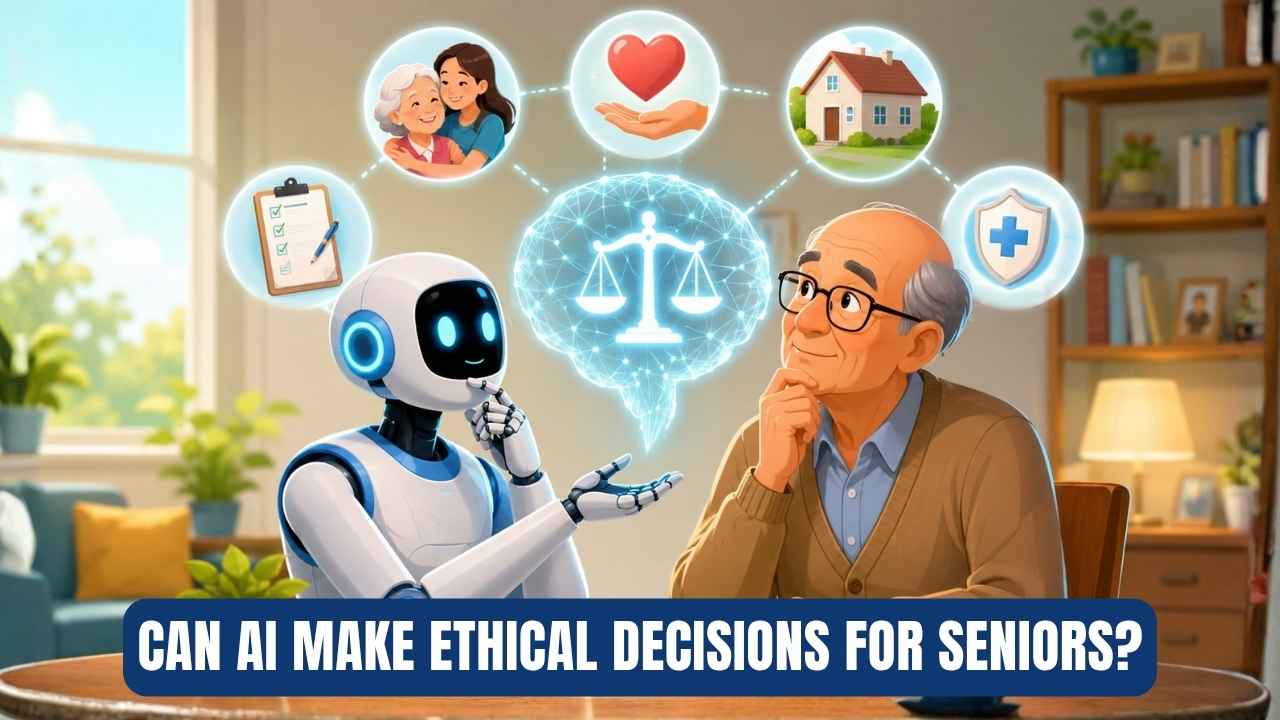

Picture this: your 78-year-old mother has a smart pill dispenser that flags a missed dose to her doctor. A wearable tracks her heart rate and calls for help if she falls. An algorithm quietly reviews her lab results before her physician even sees them. It sounds like the future finally showing up for the people who need it most.
But here’s the question nobody’s fully answered yet: when that AI has to make a judgment call — not just report data, but decide something that affects your mother’s health, privacy, or independence — is it actually making an ethical decision? Or is it just following instructions and hoping the outcome looks ethical?
This matters more than it might seem. Seniors are one of the fastest-growing groups interacting with AI systems, often without fully choosing to. Let’s dig into what AI can genuinely offer elderly care, where it quietly falls short, and what families should be asking before they hand over trust.
What “Ethical Decision-Making” Actually Means Here
Before judging whether AI can do this, it helps to know what “ethical” means in elder care specifically. Medical ethics has leaned on four core principles for decades:
- Autonomy — respecting a person’s right to make their own choices
- Beneficence — actively doing good for the person
- Non-maleficence — avoiding harm
- Justice — treating people fairly and equitably
These principles were built for human judgment — doctors, nurses, and family members weighing context, emotion, and nuance in real time. AI doesn’t weigh anything. It calculates. That distinction is the heart of this whole debate.
Where AI Is Genuinely Helping Seniors
It would be unfair to only focus on the risks — AI is already doing real, measurable good in elder care:
- Fall detection and emergency response systems that alert caregivers within seconds
- Medication management tools that reduce dangerous missed or doubled doses
- Predictive health monitoring that can catch early warning signs of illness before a crisis
- Companionship technology, like conversational AI, that eases isolation for seniors who live alone
- Clinical decision support systems that give doctors faster, evidence-based recommendations during time-pressured care
For overstretched caregivers and short-staffed care facilities, this isn’t a luxury — it’s often the difference between catching a problem early and missing it entirely.
Where It Gets Ethically Complicated
Here’s where the conversation has to get honest.
AI doesn’t understand consent — it processes permission. A senior with mild cognitive decline may “agree” to data sharing without fully grasping what’s being collected or how it’s used. Research on AI and elder care has repeatedly flagged this as one of the most pressing concerns: technology adoption that looks consensual on paper but isn’t truly informed in practice.
Bias doesn’t disappear just because a system is automated. If an algorithm is trained mostly on younger or healthier populations, it can misread the needs of older adults — especially those with multiple chronic conditions, disabilities, or from underrepresented backgrounds. An ethical decision requires fairness. A biased dataset can’t deliver that, no matter how confident the output looks.
Privacy and autonomy are constantly in tension. The same sensor that detects a dangerous fall is also recording a senior’s every movement in their own home. Where’s the line between protective monitoring and quiet surveillance? Most families haven’t been given a clear answer, because most companies haven’t had to give one.
There’s a real risk of dehumanizing care. When a check-in call, a companionship chat, or a wellness “conversation” comes from a machine instead of a person, something subtle but important can get lost. Studies on older adults’ attitudes toward AI consistently find the same fear: that convenience will come at the cost of genuine human connection.
Accountability gets blurry. If an AI system delays flagging a health decline and a senior is harmed, who’s responsible? The developer? The care facility? The algorithm itself? Right now, the honest answer in most cases is: it’s still being figured out.
So, Can AI Actually Make Ethical Decisions?
Not on its own — and most researchers in this space agree. AI can support ethical outcomes. It can surface information faster, catch patterns humans might miss, and free up caregivers’ time for the parts of care that require empathy. But the actual ethical judgment — weighing autonomy against safety, dignity against risk — still needs a human in the loop.
The most responsible systems being built today aren’t designed to replace that judgment. They’re designed to inform it: giving doctors, families, and seniors themselves better information to make the call together.
Questions Families Should Ask Before Trusting AI in Elder Care
If your family is considering an AI-powered care tool, monitoring system, or health app for an aging parent, it’s worth asking:
- Can the senior opt in or out, and do they genuinely understand what they’re agreeing to?
- Is there a clear, plain-language explanation of what data is collected and who sees it?
- Was the system tested on a population that actually reflects older adults, including those with disabilities or chronic illness?
- Is there always a human — a doctor, nurse, or care coordinator — reviewing the AI’s output before a decision is acted on?
- Does the technology add to human connection, or quietly replace it?
If a provider can’t answer these clearly, that’s a signal to slow down, not speed up.
The Bottom Line
AI isn’t going to make ethical decisions for your loved ones — at least not yet, and arguably not ever in the full sense of the word. What it can do is help the humans around them make better, faster, more informed ones. The technology is a tool for care, not a substitute for it. The families who benefit most from AI in elder care will be the ones who keep asking hard questions instead of assuming the machine has already asked them.
Disclaimer: This article is provided for general informational and educational purposes only and does not constitute medical, legal, financial, or professional advice. AI technologies referenced here vary widely in design, regulation, and reliability, and their appropriateness for any individual should be evaluated with a qualified healthcare provider, elder law attorney, or care professional. The author and publisher make no representations or warranties regarding the accuracy, completeness, or suitability of this content for any particular situation and accept no liability for decisions made based on it. Always consult a licensed professional before making healthcare, caregiving, or technology decisions on behalf of yourself or a loved one.
Disclaimer
This article is for informational purposes only and does not constitute medical, legal, or financial advice. Individual needs vary widely. Always consult with qualified healthcare providers, licensed financial advisors, or elder care professionals before making decisions regarding senior living arrangements.
Download these helpful checklists to guide you through your buying and selling journey.

Home Buyer’s Checklist

Home Seller’s Checklist

Mistakes To Avoid

10 Body Changes After 60 Worth Discussing With Your Doctor
Download these helpful checklists to guide you through your buying and selling journey.Home Buyer's ChecklistHome Seller's ChecklistMistakes To Avoid
Morning Headaches in Seniors: 9 Causes, Warning Signs and What to Do
Download these helpful checklists to guide you through your buying and selling journey.Home Buyer's ChecklistHome Seller's ChecklistMistakes To Avoid
Sudden Weight Gain From Fluid Retention: Causes, Warning Signs & What to Do
Download these helpful checklists to guide you through your buying and selling journey.Home Buyer's ChecklistHome Seller's ChecklistMistakes To Avoid