
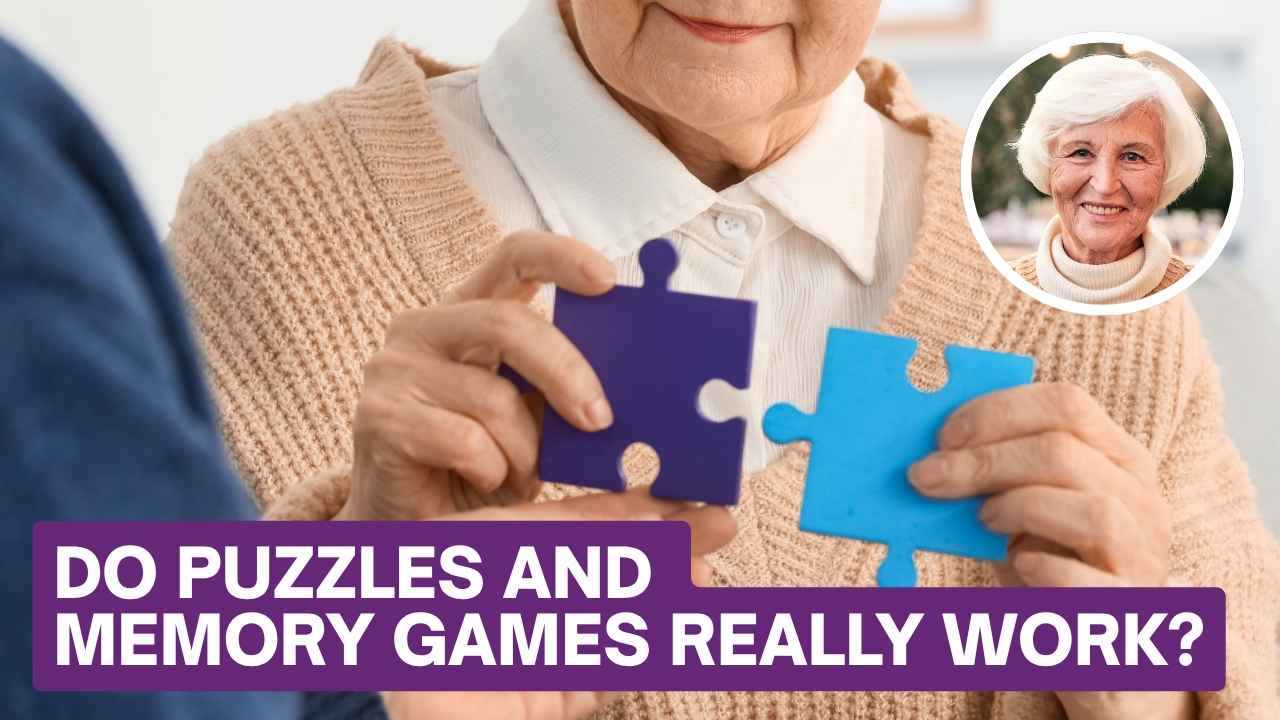

You finish a crossword puzzle, beat your best Sudoku time, or finally remember where all those matching cards are hiding.
For a moment, you feel pretty sharp.
But then comes the bigger question:
Are these puzzles actually helping your brain, or are you simply getting better at solving puzzles?
It is an important question, especially as more people turn to brain games, memory apps, crossword puzzles, Sudoku, word games, and other mental exercises in hopes of keeping their memory strong as they age.
The answer is more interesting than a simple yes or no.
Research suggests that brain games and puzzles can help exercise certain thinking skills. They may improve performance on the activities you practice and can be a useful part of staying mentally active. But there is currently no strong evidence that doing puzzles alone can prevent dementia or completely stop age-related cognitive decline.
So, should you keep doing your daily crossword?
Probably.
Just do not expect one puzzle a day to carry the entire responsibility for your brain health.
Puzzles can challenge memory, attention, reasoning and problem-solving, but different activities exercise different skills.
Do Puzzles and Brain Memory Games Really Work?
Short answer: They can help, but their benefits have limits.
Brain training games typically challenge skills such as:
When you repeatedly practice one of these abilities, you often become better at that particular task.
For example, someone who regularly completes crossword puzzles may become faster at recalling words and recognizing clues. Someone who plays matching games may improve at remembering where certain items appeared.
Researchers sometimes describe this as improvement in trained or closely related skills.
The harder question is whether those improvements transfer to everyday life.
Think beyond the game
Does winning at a memory game mean you will stop forgetting names? Will Sudoku help you remember where you put your keys? Can crossword puzzles prevent Alzheimer's disease?
That is where the scientific evidence becomes much less certain.
Brain Games Often Make You Better at Brain Games
This may sound obvious, but it is one of the most important things to understand about brain training.
Practice works.
If you repeatedly train a skill, your brain becomes more familiar with the task. You learn patterns, strategies, and shortcuts.
A meta-analysis of commercial computerized cognitive games in adults over age 60 found improvements in areas including processing speed, working memory, executive function, and verbal memory. However, benefits varied depending on the cognitive skill being measured.
Other research has reached more cautious conclusions, particularly when researchers ask whether improvements from brain games carry over into broader thinking abilities and everyday activities.
This is sometimes called the transfer problem. Getting better at a memory game is one thing. Becoming noticeably better at remembering appointments, managing finances, following conversations, or learning new information is another.
That difference matters when companies advertise brain games as a way to dramatically improve memory or protect against cognitive decline.
Can Brain Games Prevent Dementia?
This is probably the question many people really want answered.
At this time, there is not strong evidence that commercial brain games or puzzles can prevent dementia on their own.
The Alzheimer's Society notes that brain training may improve certain aspects of memory and thinking, but evidence that it reduces the risk of developing dementia remains limited.
The National Institute on Aging also recommends caution with products claiming that computer games can improve memory or prevent brain disorders. Research into cognitive training is ongoing, but commercially available brain-training programs should not automatically be assumed to provide the same benefits found in controlled research programs.
That does not make puzzles useless.
It simply means we should give them the right job.
What About Crossword Puzzles?
Crosswords are particularly interesting because some research suggests they may offer meaningful cognitive stimulation.
A randomized clinical trial involving 107 adults with mild cognitive impairment compared computerized crossword puzzles with computerized cognitive games over 78 weeks.
Surprisingly, the crossword group performed better than the computerized games group on the study's primary cognitive outcome. Researchers also observed differences in a measure of daily functioning.
That sounds promising, but there is an important limitation.
The study was relatively small, and researchers have emphasized the need for larger studies and additional control groups before drawing broad conclusions.
Crosswords look interesting. They are not a proven treatment.
Still, if you enjoy doing crosswords, there is very little reason to stop.
They challenge vocabulary, memory retrieval, reasoning, pattern recognition, and general knowledge all at once.
And perhaps just as importantly, they can be enjoyable.
An activity you actually want to do is much easier to maintain than a "brain workout" that feels like homework.
Is Sudoku Good for Your Brain?
Sudoku challenges a slightly different set of skills.
Instead of vocabulary and word recall, Sudoku relies heavily on:
You need to remember possible number placements while simultaneously checking rows, columns, and boxes.
That certainly makes your brain work.
But again, becoming excellent at Sudoku does not automatically mean every part of your memory will improve.
A good strategy is to vary your mental activities instead of doing the exact same puzzle every day.
If Sudoku is easy for you now, challenge yourself with something unfamiliar.
Your brain tends to benefit most from activities that actually require effort.
Your Brain Likes New Challenges
One of the most valuable ideas in brain health is not simply "do puzzles."
Keep learning.
When you constantly repeat something you have mastered, the activity may become less mentally demanding.
A crossword enthusiast who has solved puzzles every morning for 30 years may still enjoy them, but learning a completely new skill could provide a different type of cognitive challenge.
You could try:
Learning something unfamiliar can add a different kind of mental challenge than repeating a skill you already know well.
The National Institute on Aging notes that meaningful activities and learning new skills may offer cognitive and social benefits, although research into their long-term effects continues.
The goal is not to keep your brain busy every second.
The goal is to keep giving it reasons to learn.
The Best Brain Game Might Include Other People
There is another part of brain health that often gets overlooked.
Social interaction is mentally demanding.
Think about everything your brain does during a simple conversation.
That is a surprisingly complex cognitive workout.
So instead of always playing a brain game alone on a phone, consider turning mental activity into something social.
Try playing:
A puzzle night with friends might give you mental stimulation and social interaction at the same time.
What Actually Supports Brain Health?
If your goal is healthy aging and maintaining cognitive function, do not focus only on games.
Brain health is connected to overall health.
Factors such as physical activity, cardiovascular health, sleep, nutrition, hearing, social interaction, and management of health conditions can all matter.
Mental activity is only one piece of healthy aging. Movement, sleep, nutrition and social connection can also matter.
The National Institute on Aging recommends a broader approach to cognitive health that includes staying physically active, managing chronic conditions, eating well, getting adequate sleep, and remaining socially and mentally engaged.
So instead of thinking:
"What is the best game for my brain?"
A better question may be:
"How can I build a lifestyle that keeps both my brain and body active?"
That might include a crossword in the morning, a walk in the afternoon, dinner with friends, learning something new, and getting enough sleep at night.
That is a much more complete approach.
Are Memory Games Worth Your Time?
Yes, especially if you enjoy them.
Memory games can provide structure, challenge, entertainment, and mental stimulation.
They may also motivate people to use cognitive abilities that they otherwise might not exercise very often.
The key is keeping your expectations realistic.
Think of it as mental exercise
A brain game should not be viewed as medicine. It should be viewed as mental exercise.
And just like physical exercise, variety can be valuable.
You would not expect one exercise to strengthen every muscle in your body.
Similarly, one type of puzzle probably should not be expected to train every aspect of your brain.
Try the "Brain Variety" Approach
Instead of searching endlessly for the perfect brain game, try building variety into your week.
You do not need to follow this exact schedule.
The point is variety.
Challenge memory one day. Challenge reasoning another. Add physical movement. Add social connection. Add curiosity.
That creates a much richer form of mental stimulation than repeatedly tapping the same brain-training app.
What If You Are Already Good at Puzzles?
Make them harder.
Or change the type of challenge.
If you can finish a crossword without thinking very hard, the activity may not be providing the same challenge it once did.
You do not have to frustrate yourself.
But an activity should require at least some concentration, learning, or problem-solving.
Can You Start Brain Games Later in Life?
Absolutely.
There is no requirement that mental stimulation must begin when you are young.
Older adults can continue learning new skills and participating in mentally challenging activities.
Research into healthy aging increasingly emphasizes staying mentally, physically, and socially active throughout life.
You do not need to become a chess master or complete expert-level Sudoku.
Start with something enjoyable.
Then allow it to become slightly more challenging over time.
The best brain activity is often the one you will actually continue doing.
When Forgetfulness Is More Than Normal Aging
Occasionally forgetting someone's name, misplacing your keys, or walking into a room and wondering why you went there can happen to many people.
But noticeable or worsening memory problems should not simply be treated with more puzzles.
The National Institute on Aging recommends speaking with a healthcare professional when memory problems persist or interfere with daily life.
Examples that may deserve medical attention include increasing difficulty with:
- Remembering important appointments
- Managing medications
- Handling finances
- Finding familiar places
- Following conversations
- Completing familiar tasks
- Remembering information you recently learned
A crossword puzzle is not a diagnostic test, and a brain-training app should never replace professional medical evaluation.
So, Do Puzzles and Brain Memory Games Work?
Yes, but perhaps not in the magical way advertisements sometimes suggest.
Puzzles and memory games can challenge your brain.
They can improve your ability to perform certain tasks.
Some forms of cognitive training may produce modest improvements in memory, processing speed, attention, and other cognitive abilities.
What they have not convincingly been shown to do is guarantee protection against dementia or permanently stop cognitive decline.
And that is okay.
You do not need your crossword puzzle to be a miracle treatment for it to be worthwhile.
If solving puzzles gets you thinking, learning, concentrating, and having fun, that has value.
Look beyond the puzzle book.
Give your brain more than one type of challenge.
Because keeping your mind active is less about finding one perfect brain game and more about continuing to use your brain in different, meaningful ways.
Frequently Asked Questions
Do crossword puzzles improve memory?
Crossword puzzles challenge word recall, vocabulary, reasoning, and memory retrieval. Some research has shown promising results, including a small clinical trial involving adults with mild cognitive impairment. However, crosswords have not been proven to prevent dementia.
Are brain games good for older adults?
They can be. Brain games may help exercise memory, attention, reasoning, processing speed, and problem-solving skills. They are best used alongside physical activity, social engagement, healthy sleep, and other healthy lifestyle habits.
Can Sudoku prevent dementia?
There is currently no strong evidence showing that Sudoku by itself prevents dementia. It can still be an enjoyable way to practice reasoning, attention, and problem-solving.
How often should seniors do brain games?
There is no universally established amount of puzzle time that guarantees better brain health. Consistency, variety, appropriate challenge, and enjoyment are more useful goals than chasing a specific number of minutes.
What is the best memory game for seniors?
There is no single best game. Crosswords, matching games, card games, word puzzles, Sudoku, trivia, chess, and strategy games can all challenge different mental abilities. Variety may be more useful than repeatedly playing only one type.
Can brain games reverse memory loss?
Brain games should not be considered a treatment for unexplained or worsening memory loss. Anyone experiencing persistent or significant memory changes should discuss them with a qualified healthcare professional.
Disclaimer
This article is provided for general educational and informational purposes only. It is not intended to provide medical advice, diagnosis, treatment, or a substitute for professional healthcare. Research on brain training, memory games, cognitive health, Alzheimer's disease, dementia, and cognitive decline continues to evolve, and individual results may vary. Puzzles and brain games should not be relied upon to prevent, diagnose, or treat dementia, memory disorders, or other medical conditions. Anyone experiencing new, persistent, worsening, or concerning changes in memory, thinking, behavior, or ability to perform everyday activities should consult a qualified healthcare professional. Always seek individualized medical guidance before making decisions concerning your health or treatment.

10 Body Changes After 60 Worth Discussing With Your Doctor
Download these helpful checklists to guide you through your buying and selling journey.Home Buyer's ChecklistHome Seller's ChecklistMistakes To Avoid
Morning Headaches in Seniors: 9 Causes, Warning Signs and What to Do
Download these helpful checklists to guide you through your buying and selling journey.Home Buyer's ChecklistHome Seller's ChecklistMistakes To Avoid

Sudden Weight Gain From Fluid Retention: Causes, Warning Signs & What to Do
Download these helpful checklists to guide you through your buying and selling journey.Home Buyer's ChecklistHome Seller's ChecklistMistakes To Avoid
Download these helpful checklists to guide you through your buying and selling journey.

Home Buyer’s Checklist

Home Seller’s Checklist

Mistakes To Avoid