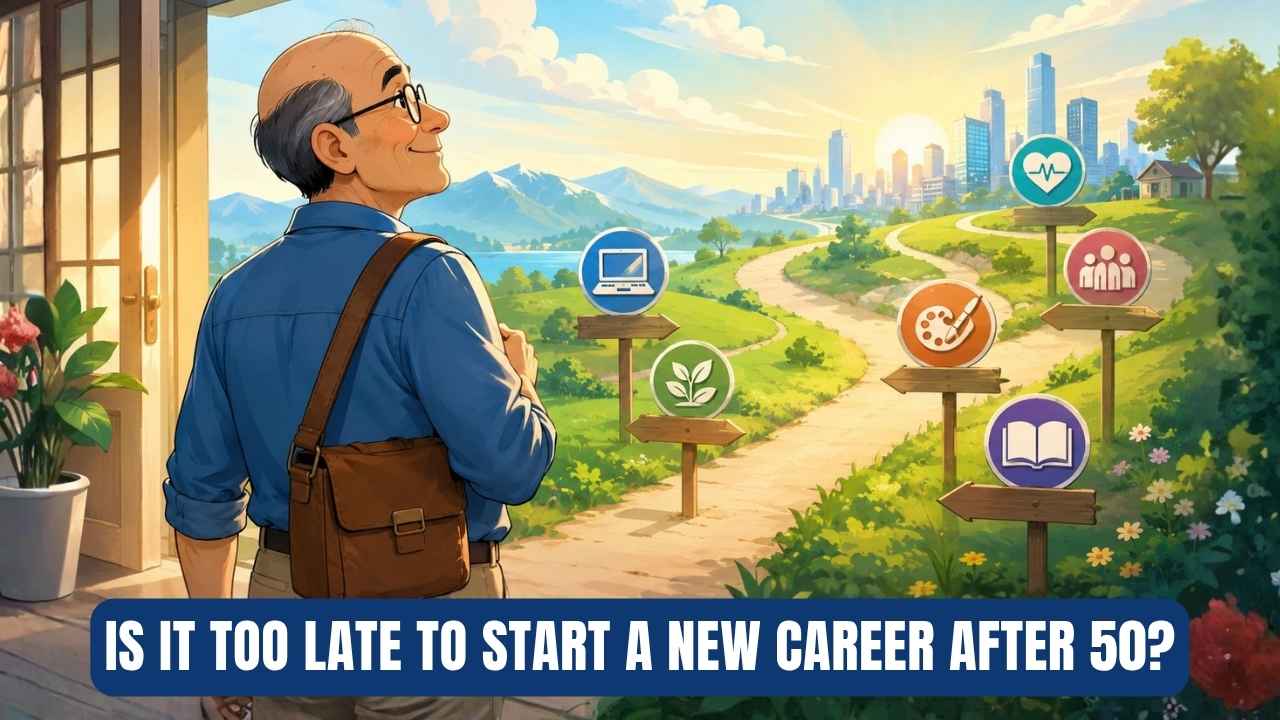

Let’s get the big question out of the way first: no, it is not too late to start a new career after 50. Not even close.
If you’re reading this, you’re probably somewhere between “I can’t picture doing this job for another decade” and “but is it actually realistic to change everything now?” That’s a completely normal place to be. And the good news is that the data, the workplace trends, and thousands of real career-changers all point in the same direction — 50 is not an ending. For a lot of people, it’s the moment everything finally starts making sense.
Why So Many People Feel “Stuck” Around 50
It rarely happens out of nowhere. A career change after 50 usually shows up after one of a few familiar triggers:
- Burnout that’s been quietly building for years
- A layoff that forces the question you’d been avoiding
- New caregiving responsibilities that demand more flexibility
- Simply realizing the gap between the work you’re doing and the life you actually want has gotten too wide to ignore
None of these are signs of failure. They’re signs that you’ve lived enough of your career to know what isn’t working — which, ironically, is exactly what makes a second career more likely to succeed than your first one.
The Numbers Actually Favor You
This is where most people are surprised. Career changes later in life aren’t just “possible” — they’re often financially smart.
Research from the Organisation for Economic Co-operation and Development found that workers aged 45 to 54 who voluntarily switched jobs saw average wage growth of 7.4%, and even those aged 55 to 64 still saw a 3.5% increase. In other words, changing lanes at midlife doesn’t automatically mean starting over from zero financially — many people come out ahead.
And in the UK, roughly one in three workers is now over 50, meaning mature employees aren’t the exception in today’s workforce — they’re a significant and growing part of it. Employers increasingly value what that experience brings to the table: reliability, judgment, and staying power.
What’s Actually Working in Your Favor at 50
It’s easy to focus on what might work against you — but the honest list of advantages is longer than most people expect:
1. You know yourself. At 20, you’re guessing at what might make you happy. At 50, you’re not guessing anymore. You know your strengths, your non-negotiables, and the kind of environment that drains you versus the kind that energizes you.
2. You have transferable skills you’re probably underselling. Project management, communication, negotiation, mentoring, problem-solving under pressure — these don’t expire. They just need to be repackaged for a new industry.
3. You likely have more financial breathing room than you did at 25. Years of saving and investing can give you the runway to retrain, take a pay cut temporarily, or start something entrepreneurial without the same risk you’d have faced earlier in life.
4. Employers are actively looking for what you offer. A strong work ethic, follow-through, and emotional steadiness are in short supply — and mature workers tend to bring all three, along with lower turnover.
5. “Too old” is mostly a story, not a fact. Much of the hesitation around changing careers at 50 comes from internal self-doubt — what career experts often call self-imposed ageism — rather than any real barrier in the job market.
How to Actually Start a New Career After 50 (Without the Overwhelm)
Wanting a change and knowing how to execute it are two different things. Here’s a grounded, step-by-step way to approach it.
1. Get clear on why your current path stopped working
Before you chase the next thing, understand what you’re actually leaving behind. Was it the role, the industry, the company culture, or something more personal like burnout? If you skip this step, there’s a real risk of recreating the same dissatisfaction in a brand-new setting.
2. Identify your non-negotiables
What does your next chapter actually need to include for you to feel fulfilled — flexibility, purpose, income stability, creative freedom? Get specific. Vague goals lead to vague decisions.
3. Audit your transferable skills
List what you’ve built over the last 20–30 years, then match it against industries or roles that need exactly that. You’re not starting from zero — you’re pivoting from a position of strength.
4. Fill the gaps strategically
If a new field requires skills you don’t have yet, there’s more accessible training than ever:
- Bootcamps (especially for tech-adjacent roles) that can be completed in months
- Community college or certificate programs
- Volunteer work or part-time roles to build real experience
- A full degree, if the field genuinely calls for it — it’s never “too late” to earn one
5. Consider working with a career coach
An outside perspective can help you cut through the noise, especially the self-doubt that tends to creep in. A good coach helps you separate real obstacles from imagined ones.
6. Start before you’re “ready”
Side projects, freelance work, informational interviews, and volunteering all let you test-drive a new direction with low risk before making it official.
Popular Second-Career Paths for People Over 50
There’s no single “right” path, but a few directions tend to come up again and again for people making this shift:
- Teaching or training — a natural fit if you want to pass along deep industry knowledge
- Consulting or freelancing in your former field, but on your own terms
- Healthcare-adjacent or caregiving roles, which are in high and growing demand
- Skilled trades, many of which offer fast certification paths and strong job security
- Entrepreneurship, turning decades of expertise into a business of your own
- Nonprofit or purpose-driven work, for those ready to prioritize meaning over prestige
The Real Talk: What Makes This Harder (And How to Handle It)
It wouldn’t be honest to pretend a career change at 50 is effortless. There are real challenges worth naming:
- Self-doubt. Even highly successful people often quietly wonder, “Who would hire me to do something new?” This is common — and it’s rarely backed by reality once you actually start applying and networking.
- Financial planning. A transition may mean a temporary pay cut or retraining costs, so it’s worth mapping out your finances before you leap, not after.
- Learning curve. Picking up new tools or terminology can feel humbling after years of expertise elsewhere — but it moves faster than most people expect once momentum builds.
None of these are reasons to stay stuck. They’re just things to plan for.
The Bottom Line
Is it too late to start a new career after 50? No — and the people who’ve already done it, along with the data behind midlife career changes, back that up clearly. What matters most isn’t your age. It’s clarity about what you want, a realistic plan to get there, and the willingness to start before you feel completely ready.
You’ve already spent decades building skills, judgment, and resilience. A new career after 50 isn’t starting from scratch — it’s building on everything you’ve already earned.
Disclaimer: This article is for general informational purposes only and does not constitute professional career, financial, or legal advice. Individual circumstances vary, and readers should consult a qualified career counselor, financial advisor, or other relevant professional before making significant career or financial decisions. While every effort has been made to ensure accuracy at the time of publication, the author and publisher make no guarantees regarding outcomes and are not liable for any actions taken based on the information provided in this article.
Disclaimer
This article is for informational purposes only and does not constitute medical, legal, or financial advice. Individual needs vary widely. Always consult with qualified healthcare providers, licensed financial advisors, or elder care professionals before making decisions regarding senior living arrangements.
Download these helpful checklists to guide you through your buying and selling journey.

Home Buyer’s Checklist

Home Seller’s Checklist

Mistakes To Avoid

10 Body Changes After 60 Worth Discussing With Your Doctor
Download these helpful checklists to guide you through your buying and selling journey.Home Buyer's ChecklistHome Seller's ChecklistMistakes To Avoid

Morning Headaches in Seniors: 9 Causes, Warning Signs and What to Do
Download these helpful checklists to guide you through your buying and selling journey.Home Buyer's ChecklistHome Seller's ChecklistMistakes To Avoid

Sudden Weight Gain From Fluid Retention: Causes, Warning Signs & What to Do
Download these helpful checklists to guide you through your buying and selling journey.Home Buyer's ChecklistHome Seller's ChecklistMistakes To Avoid